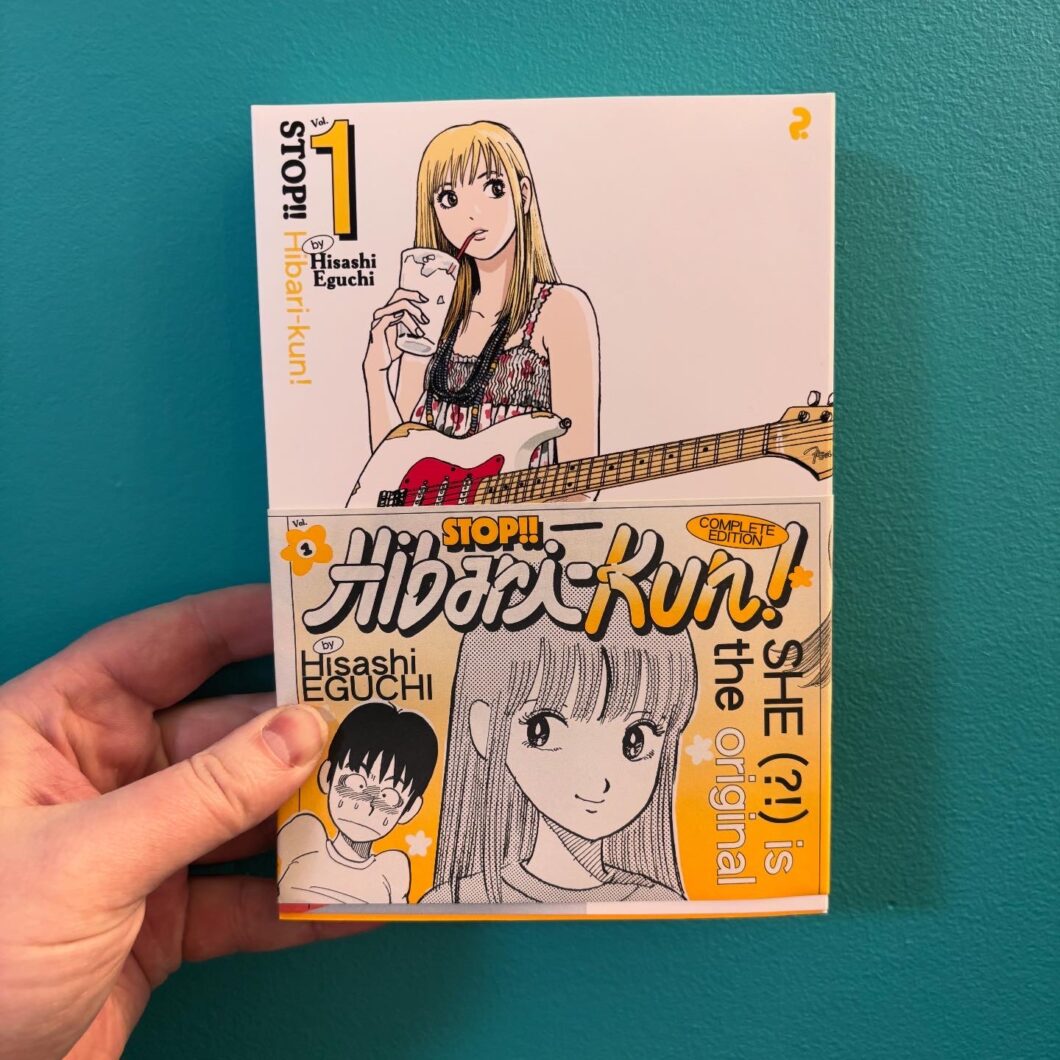
There’s a wonderful company my store has been ordering books from called Peow2 – a small press filled to the brim with mighty ideas, and an incredible attention to quality and detail.
At the end of the year, the company offered an intriguing reprint that sat slightly outside of their wheelhouse.
When I ordered this book, I wasn’t quite familiar with the material. At this point, I generally take the fact that Peow2 has taken the effort to put something in print as a sign of quality, so I ended up slowly discovering bits and pieces of this intriguing book as I read and dug from resources.
Stop!! Hibari-Kun! by Hisashi Eguchi was published in the early 80s, and is heralded as one of the earliest (and kindest) depictions of trans identity in manga. Much like a lot of content from decades past, it isn’t perfect in being sensitive to a wide range of topics, but the heart is unmistakable.
One of my goals for 2026 is to showcase the writing of others when it comes to media featuring a lived experience I do not share. As a cis-het white dude, I can throw a rock and find a story about someone like me – so many other folks aren’t that lucky. They also don’t always get the opportunity to be heard, so I figured the least I could do, is share the words of others when they can speak to something with far more experience and clarity than I can.
That said, when I was digging around for words about this title, I came across two very interesting pieces of writing. The first is a piece by Gabriel Hernandez entititled “Charting manga and anime’s trans history, from the ’60s through today” where this excerpt about Stop!! Hibari-Kun lives:
Hisashi Eguchi’s Stop!! Hibari-Kun! (1981) follows Hibari Ozora, the daughter of a Yakuza boss, who was assigned male at birth. Hibari’s family treats her as a man, viewing her expressive femininity as a “perversion,” or a joke at her expense. At this point, you’re probably steeling yourself for an insensitive portrayal of trans women—but that’s not the case at all. Hibari herself is never treated as the butt of a joke. If anything, the way that other characters react to her existence makes it clear that they are the ones the audience is meant to laugh at. As a trans character, Hibari is unconventional because of how outwardly happy and drama-free her life is, despite the world misunderstanding her.
Eguchi has a fondness for the character of Hibari that goes deeper than surface-level pride for his work. In truth, she represented the artist’s inner world, inked onto paper. To quote Eguchi himself: “The ideal girl for me is the one I would have wanted to become if I was born a girl. It is not the girl I would dream of dating. It is really the frustration of not being born as a girl which fuels my drawings.”
The second is an article that I believe is by the same writer (credited by this outlet as Gab Hernandez) called “My Fave Is Problematic: Stop!! Hibari-Kun!”
From that article:
Stop!! Hibari-Kun!’s titular character is, for me, one of the best representations of a trans woman in media—made all the more shocking by the fact that it was made in the 1980s, a time when the concept of trans women was even more deeply misunderstood than it is now.
However, with that decade came many problematic aspects, such as casual transphobia, racism, and uncomfortable sexuality. The dichotomy of Hibari as both a progressive trans narrative and an ignorant product of its time showcases Japan’s complicated relationship with trans women and other marginalized groups. As a non-binary person myself, I certainly found a lot of fun and gender envy from Stop!! Hibari-kun. I discovered it two years ago, coincidentally around the time I was coming to terms with my own identity. The confidence with which she displays her femininity is something I’ve always admired. This ironically makes it all the harder to recommend, because Stop!! Hibari-kun also has aspects that I was incredibly uncomfortable with despite its great qualities.
The rest of the article digs deep and talks in depth about the type of imperfect works that can still shine and hold meaning.
Both come together to give a fully formed context to the work that made me appreciate it a whole lot more than I would have otherwise.
In the end, I can say Stop!! Hibari-Kun is a fascinating read adorned with the inherent goofiness of an 80s comedy manga – something wholly unique in the medium today.
Stop!! Hibari-Kun is currently available directly from Peow2, or at Variant Edition Graphic Novels in Edmonton, Alberta.